Home / Quality
Seven stages from resin to released vial. A lot that fails any of them is destroyed — we do not have a second grade to sell it as.
The sequence is built one residue at a time on a resin support, with coupling efficiency monitored at each step. A single failed coupling propagates as a deletion sequence through everything downstream.
The chain is cleaved from the resin, side-chain protecting groups removed, and the crude peptide precipitated in cold ether. At this point purity is typically somewhere between 60 and 80 %.
The crude material is separated on a reversed-phase column. Fractions are collected individually and assayed — only fractions that meet specification are pooled. This is the step that costs the yield and buys the purity.
Electrospray MS confirms the observed molecular weight against the theoretical weight of the intended sequence. A deviation here ends the lot; there is no interpretation to be done.
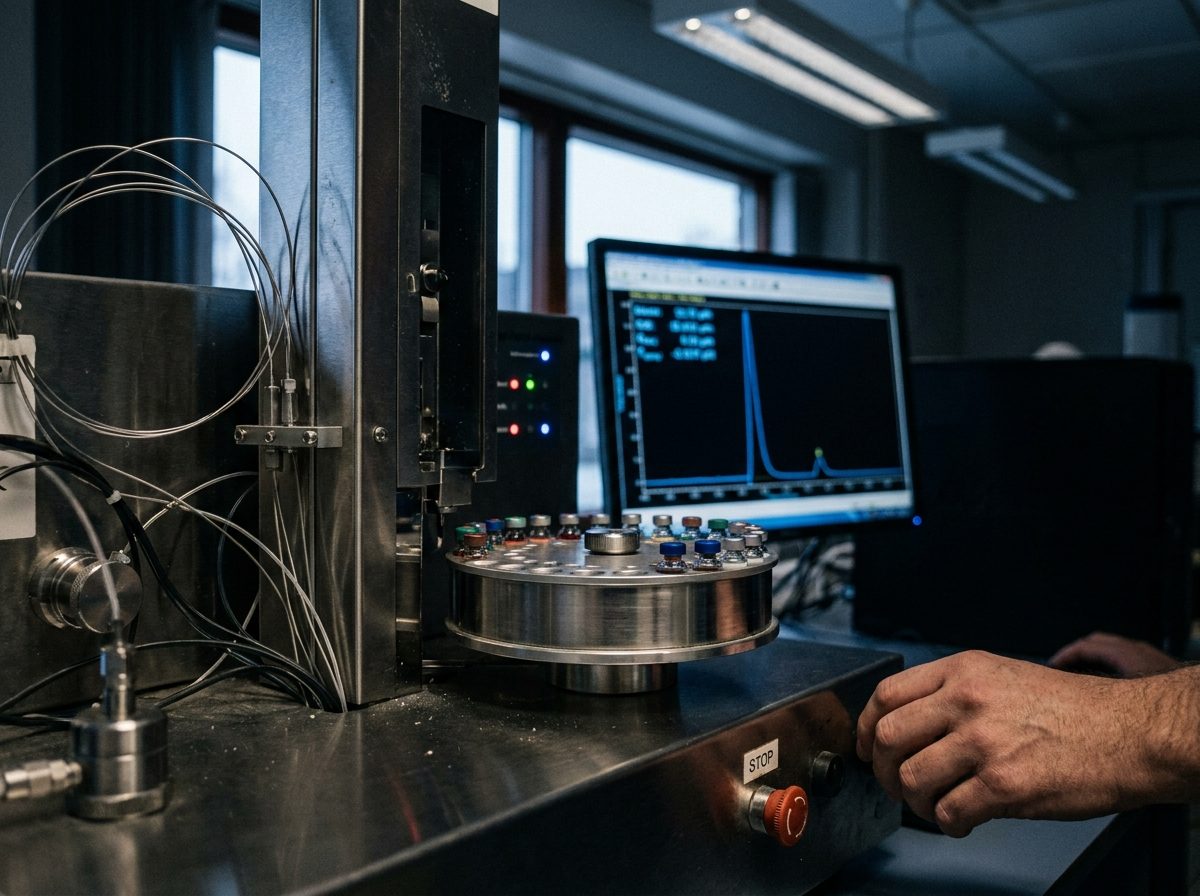
Reversed-phase, UV detection at 214 nm, area under curve. Release specification is ≥ 99 %. The chromatogram that appears on the certificate is the one from this run, unedited and unsmoothed.
Acetate counter-ion content, residual solvent and water by Karl Fischer titration. These are the numbers that determine how the powder behaves in the vial and how much peptide is actually in a nominal 10 mg fill.
Lyophilisation, filling under laminar flow, crimping, then a −20 °C quarantine hold. Nothing ships until bioburden and endotoxin results are signed off and the certificate is issued against that specific lot number.
The certificate
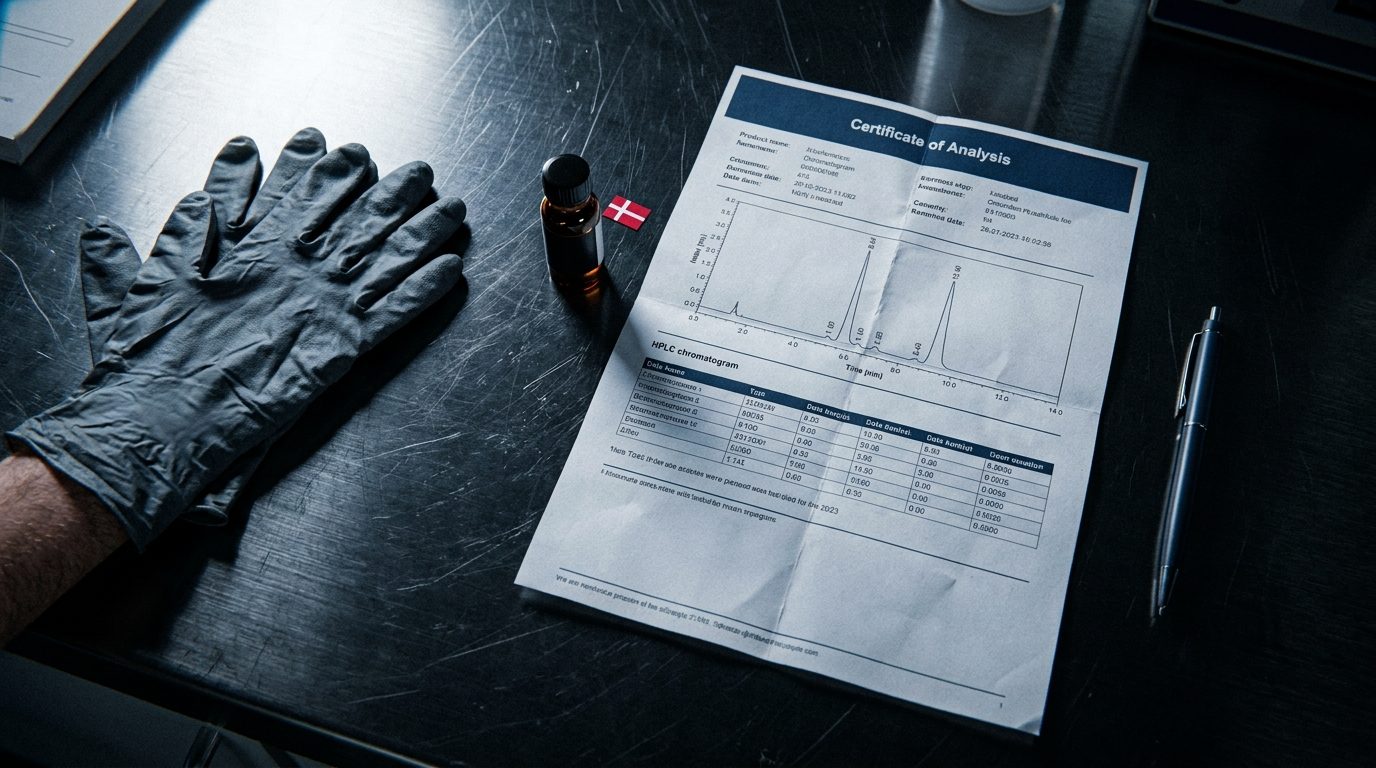
A certificate of analysis is worth exactly as much as the traceability behind it. Plenty of certificates in this market are genuine documents describing a batch nobody in the supply chain still has.
Ours name the lot, the synthesis date, the analyst and the instrument. The chromatogram is a screenshot from the run, not a redrawn illustration. If the peak has a shoulder on it, you will see the shoulder.
Illustrative certificate values. The document supplied with your order carries the results for your lot.
What we do not claim
A supplier that claims everything is claiming nothing. Here is the boundary of what a purity number can tell you.
A 99.4 % HPLC result tells you what is in the vial. It tells you nothing about whether the sequence does anything useful in your model. Those are separate questions and we only answer the first.
Nothing in this catalogue holds a marketing authorisation as a medicinal product in Denmark or the EU. They are research chemicals, supplied for laboratory work, and we will not discuss human use.
Most dose ranges on this site come from small preclinical studies. Where human data exists we say so; where it does not, the absence is the finding, and we do not fill the gap with confident language.
Send us a sequence and a lot number and we will email the certificate for it. No account required, no sales call attached.