Home / Reconstitution bench
Concentration, draw volume, syringe units and doses per vial — shown on an actual vial and an actual U-100 barrel instead of four numbers in a box.
The maths, in the open
There is nothing proprietary here. If the bench and your own calculation disagree, one of you has the wrong vial size.
Concentration
mg in vial ÷ mL of water = mg/mL
A 10 mg vial with 2 mL of bacteriostatic water gives 5 mg/mL. Add less water and every draw gets smaller — and harder to read accurately.
Draw volume
dose (mcg) ÷ concentration (mcg/mL) = mL
A 250 mcg dose from a 5000 mcg/mL solution is 0.05 mL. Everything downstream is a unit conversion of this one number.
Syringe units
mL × 100 = units on a U-100 barrel
U-100 means 100 units per millilitre. So 0.05 mL is 5 units — regardless of whether the barrel holds 30, 50 or 100 units in total.
Doses per vial
total mcg ÷ dose mcg = full doses
Rounded down, always. The last partial dose left in the vial is not a dose, and counting it is how people run short mid-protocol.
Reconstitution guide
Six steps. The order matters more than the technique.
Take the vial out of the freezer and the bacteriostatic water out of the fridge. Cold glass pulls condensation, and water is what degrades a lyophilised peptide.
Alcohol swab on the peptide vial and the water vial, and let them dry. Wet alcohol carried through the stopper ends up in your solution.
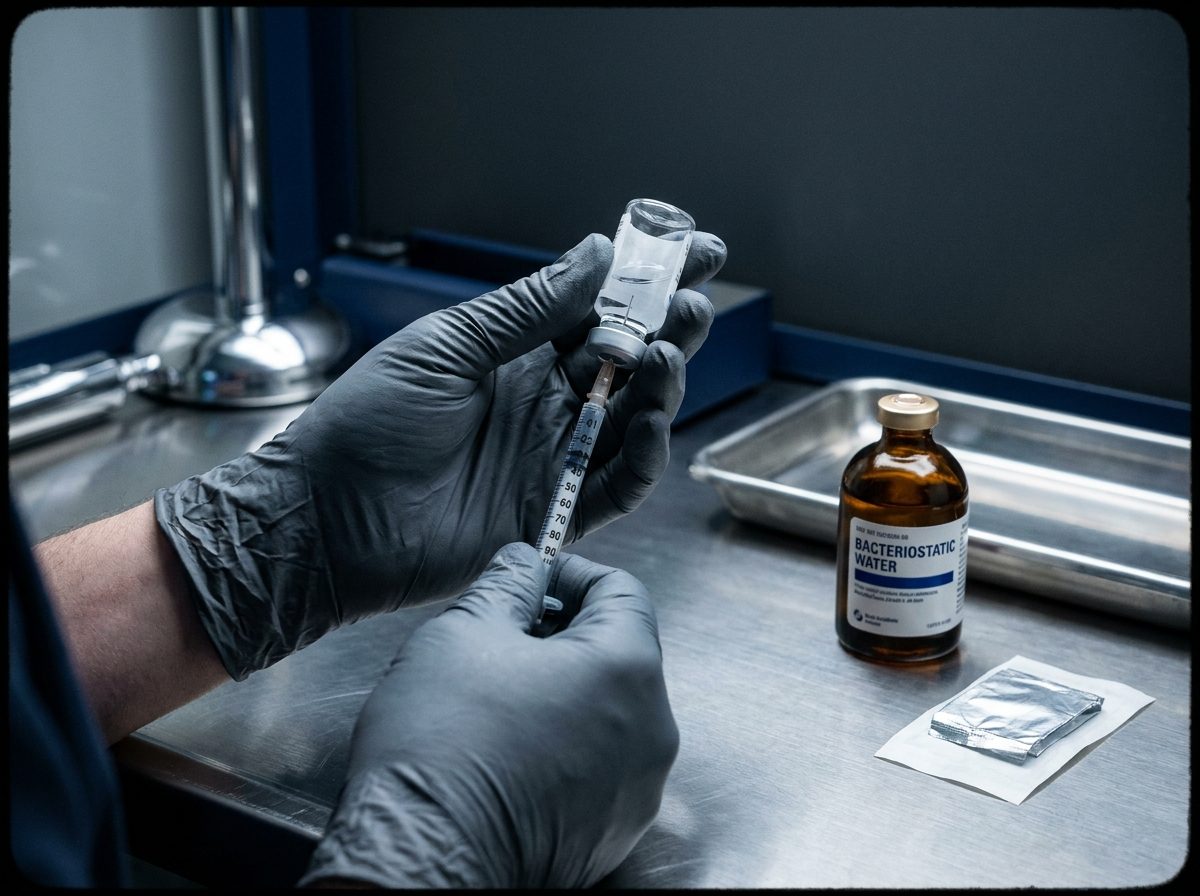
Pull the volume the bench told you into the syringe. Not the volume you remember from last time — vial sizes change.
Angle the needle so the stream hits the inside glass and runs down. Jetting water directly onto the powder cake shears the peptide.
Gentle rotation until the solution is clear. Most sequences dissolve in under two minutes. Shaking foams the surface and denatures the peptide.
Write the date on the label. Reconstituted peptide is a different product from the powder — weeks of stability instead of years.
Syringe & measurement
The single most common error in this field is treating the number on the barrel as a dose. It is a volume — and what that volume contains depends entirely on how much water you added.
| Barrel | Total volume | Smallest readable mark | Best for |
|---|---|---|---|
| 30 unit | 0.3 mL | 1 unit (0.01 mL) | Small draws under 30 units — the most accurate barrel for microgram dosing |
| 50 unit | 0.5 mL | 1 unit (0.01 mL) | Mid-range draws where a 30-unit barrel would overflow |
| 100 unit | 1.0 mL | 2 units (0.02 mL) | Large draws and reconstitution itself — least precise for small volumes |
A 6-unit draw on a 100-unit barrel sits between two marks. The same draw on a 30-unit barrel lands on a line you can actually see. The bench flags this for you.
If your draw is smaller than three units, the measurement error starts to rival the dose. Reconstitute with more water and draw a larger, readable volume of a weaker solution.
The plunger's rubber seal has a front and a back edge. Read the front edge — the one nearest the needle — consistently, every time.
Storage
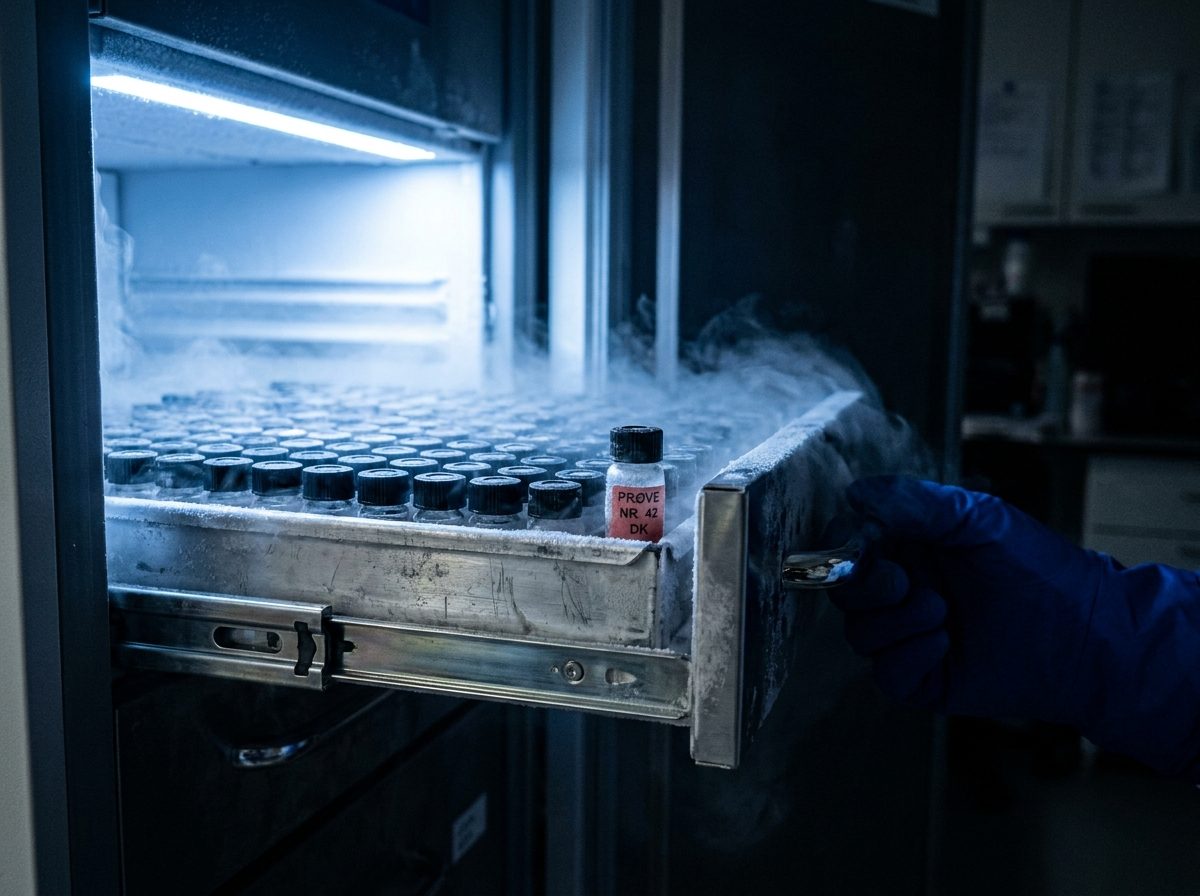
A lyophilised peptide at −20 °C, protected from light, is stable for years. The same peptide dissolved in bacteriostatic water at 2–8 °C is stable for weeks. Adding water is not a small step — it starts a clock.
Bacteriostatic water contains 0.9% benzyl alcohol, which suppresses microbial growth after the stopper has been punctured. Sterile water without a preservative has no such protection and should be treated as single-use.
Freeze-thaw cycling is the other quiet killer. Each cycle costs you a little of the peptide. If a protocol runs long, aliquot into single-use portions once, rather than returning the same vial to the freezer repeatedly.